
Geo-arbitrage means earning in a strong currency like USD, EUR, or GBP while living somewhere your money goes much further. You keep your income and cut your cost of living, so the gap you can save and invest gets a lot wider.
Tim Ferriss put the term on the map in The 4-Hour Workweek. It used to sound like a fringe move for a handful of bloggers. It isn’t anymore. Once remote work went mainstream, hundreds of thousands of people quietly started doing it, and the FIRE crowd noticed it does something an ordinary savings plan can’t.
How Geo-Arbitrage Works
The math is the whole pitch. Your income holds steady, sometimes it even climbs, while your expenses fall off a cliff. Here is how that plays out on a $6,000 monthly remote salary.
| Category | San Francisco | Lisbon | Chiang Mai |
|---|---|---|---|
| Rent (1BR) | $2,800 | $1,100 | $450 |
| Food & Dining | $800 | $400 | $300 |
| Transportation | $300 | $100 | $80 |
| Healthcare | $450 | $150 | $60 |
| Entertainment | $400 | $200 | $150 |
| Coworking | $350 | $200 | $100 |
| Monthly Total | $5,100 | $2,150 | $1,140 |
| Monthly Savings | $900 | $3,850 | $4,860 |
| Annual Savings | $10,800 | $46,200 | $58,320 |
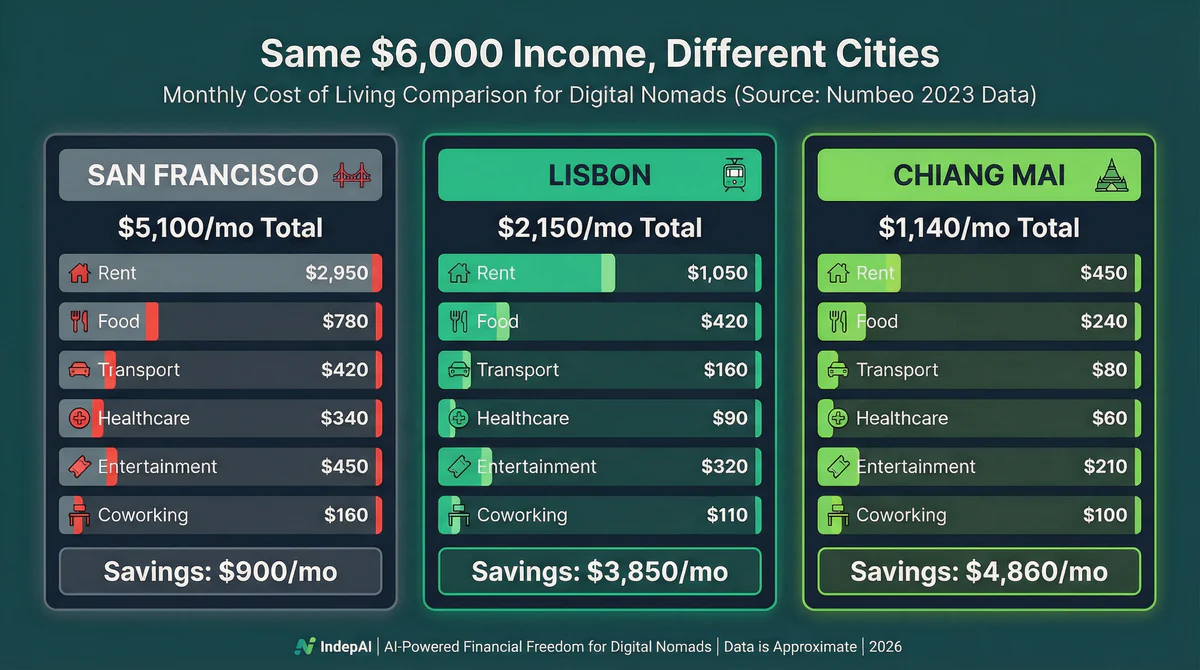
Look at the bottom row. Same job, same paycheck, and Chiang Mai leaves you with an extra $47,520 a year over San Francisco. Hold that for five years and you have banked close to a quarter of a million dollars you would never have seen at home. That is not a nicer vacation. That is years off your retirement date.
The FIRE + Geo-Arbitrage Combo
Cutting expenses does not just save money today. For anyone chasing FIRE, moving somewhere cheaper pulls three levers at once, and they compound on each other.
Most FIRE calculators assume you never move. They take your savings rate, project some growth, and hand you a date. They ignore the one variable a remote worker can change almost overnight: where you live.
First, your savings rate jumps, because more of each paycheck survives the month. That money starts compounding earlier, so the portfolio doing the heavy lifting is bigger sooner. If you also plan to retire abroad, the target itself drops: a $2,000-a-month life needs a 25x number near $600,000, not the $1.2 million a US cost of living demands. All of that pulls Coast FIRE, the point where your investments grow on their own without another dollar from you, years closer.
Run your own numbers in the FI Calculator. It is built to show this effect directly: change your city and watch your independence date move.
Best Cities for Geo-Arbitrage
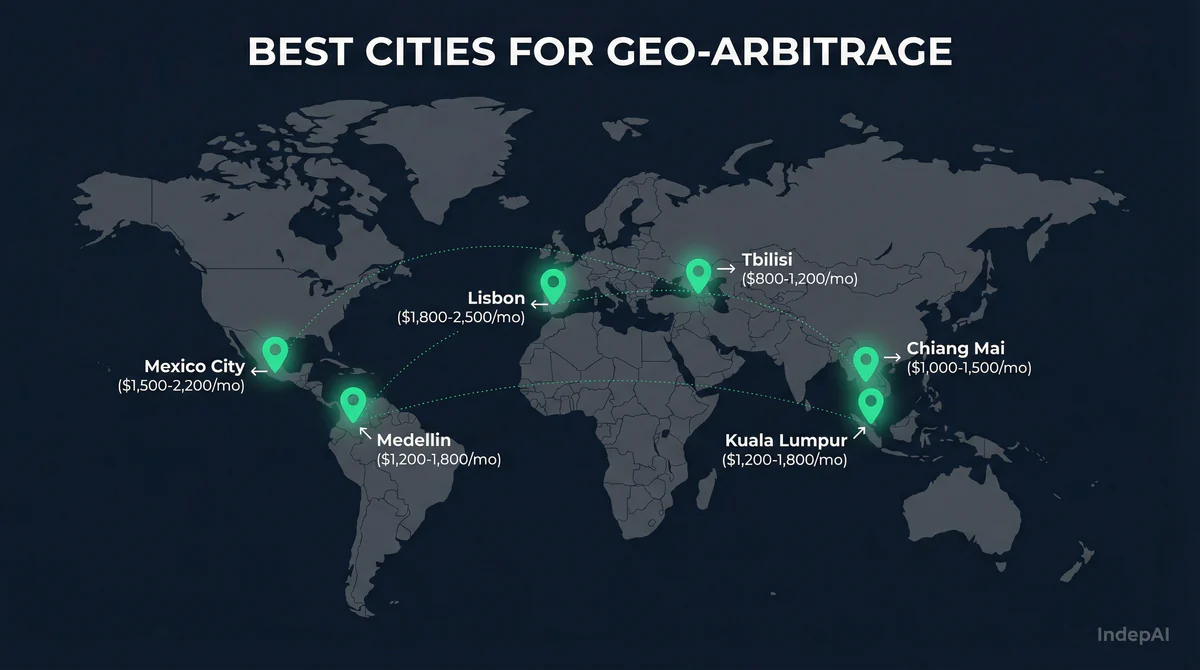
These six come up again and again, and for good reason: cheap enough to matter, wired enough to work, and pleasant enough to stay a while. The monthly budgets below assume one person living comfortably, not backpacking.
Chiang Mai, Thailand
Plan on $1,000 to $1,500 a month, the lowest on this list. You get fast internet, more coworking space than you will ever use, and a nomad community that has been here for over a decade, so the logistics hold no surprises. The food is cheap and genuinely great. Most people arrive on the 60-day tourist visa and extend it; for longer stays, the newer Long-Term Resident visa is now an option.
Lisbon, Portugal
Budget $1,800 to $2,500. It sits at the expensive end of the list, but you are paying for an EU base with real infrastructure, a serious tech scene, and some of the best food in Europe. The tax picture, mainly the NHR regime, keeps shifting, so check the current rules before you count on it. To stay put, the D7 passive-income visa and the Digital Nomad Visa both make long stays straightforward.
Medellin, Colombia
Around $1,200 to $1,800 a month buys spring weather every single day of the year, which is the thing nobody who has lived there will stop talking about. The tech scene is growing, the expat community is welcoming, and Colombia’s Digital Nomad Visa runs up to two years.
Mexico City, Mexico
Expect $1,500 to $2,200. You get world-class food, art, and nightlife for a fraction of US prices, plus time zones that line up with American teams, which matters if your clients sit in New York or California. Remote workers can apply for the Temporary Resident visa.
Tbilisi, Georgia
One of the cheapest options at $800 to $1,200, with internet far better than the price suggests. Citizens of 95-plus countries can enter visa-free for a full year. Georgia also runs a territorial tax system, so foreign-source income is generally tax-free for non-residents. That is worth a proper look if most of your money comes from abroad.
Kuala Lumpur, Malaysia
$1,200 to $1,800 a month gets you modern infrastructure, excellent and affordable healthcare, and a food scene that borrows from three cultures at once. English is everywhere, so daily life runs with almost no friction. The DE Rantau pass gives nomads a 12-month professional visit permit.
Compare these cities side-by-side with real-time cost data using the geo-arbitrage tool.
Tax Considerations
Tax is where geo-arbitrage either pays off or quietly bites you. The same move can hand you thousands more or claw a chunk back, depending on how your residency and home-country rules line up. A few things decide which way it falls.
Residency usually turns on time. Spend 183 days or more in most countries and you become a tax resident there, which is what actually determines who gets to tax you. Then there is the system that country runs. A handful, including Georgia, Panama, and Paraguay, tax only income earned inside their borders, so money you make elsewhere can land tax-free locally. Tax treaties between your home and host country exist to stop you paying twice, so check whether the two have one before you assume the worst.
US citizens and green-card holders do not get to opt out. You owe US tax on worldwide income no matter where you sleep, though the Foreign Earned Income Exclusion shields up to $126,500 of it (2025). And do not forget consumption taxes: VAT or GST varies a lot by country and feeds straight back into the cost-of-living math above.
The tax calculator can help you estimate what you would owe in different jurisdictions. For anything personal, talk to a cross-border tax professional.
Getting Started with Geo-Arbitrage
If the numbers tempt you, here is the order I would actually do this in.
Step 1: Assess Your Remote Work Flexibility
Before you daydream about Lisbon, make sure the job survives the move. Does your employer actually allow fully remote work from another country, or just from the next state over? If you freelance or run your own business, that part is handled. The real catch is overlap: do your clients or teammates need you online during specific hours, or are you genuinely async?
Step 2: Calculate Your Baseline Numbers
You cannot measure the upside without knowing where you stand now. Pull together your monthly income after tax, your current expenses broken out by category, your savings rate, and your total invested assets. Drop them into the FI Calculator to set your baseline FI timeline, the date you are trying to beat.
Step 3: Research and Compare Destinations
Weigh each candidate on more than the headline “cheap” label:
- Cost of living against your actual income, not a backpacker budget
- Visa rules and how long they let you stay
- Internet you can trust, ideally 50+ Mbps, tested on the ground
- Time-zone overlap with the people you work with
- Healthcare, both the quality and what it costs out of pocket
- Day-to-day safety and whether you would genuinely enjoy living there
- The tax situation from the section above
The geo-arbitrage tool lines these up side-by-side with real data.
Step 4: Do a Trial Run
Do not sign a year lease sight unseen. Spend one to three months in your target city first, treat it as a test, and see whether the reality matches the spreadsheet:
- Test internet reliability at the coworking spaces and cafes you would actually use
- Live the real cost of living, not the online estimate
- Build a local network of other nomads and expats before you commit
Step 5: Optimize and Iterate
Geo-arbitrage is not a one-time decision, and the people who get the most out of it treat it as ongoing:
- Move seasonally to chase better weather, lower costs, and visa windows
- Re-check your FI numbers every quarter as prices shift
- Keep more than one base to spread both risk and boredom
- Track what you actually spend against your projections, then adjust
Try the FI Calculator
See exactly how geo-arbitrage changes your Financial Independence timeline. Enter your numbers below:
Early Retirement Calculator
Estimate how much you may need and when work could become optional.
Savings rate: 40.0%
The link contains only currency and model assumptions — never your age, income, expenses or savings.
Frequently Asked Questions
What is geo-arbitrage in simple terms?
Geo-arbitrage is earning money in a high-income currency (like USD, EUR, or GBP) while living in a country where your cost of living is significantly lower. The difference between what you earn and what you spend is much larger than it would be in your home country, allowing you to save and invest more aggressively.
Is geo-arbitrage legal?
Yes, geo-arbitrage itself is completely legal. However, you must comply with tax laws in both your country of citizenship and your country of residence. Many countries have tax treaties to avoid double taxation. Some digital nomads structure their affairs through countries with territorial tax systems. Always consult a tax professional familiar with cross-border taxation.
How much can I really save with geo-arbitrage?
Savings vary enormously by location. Moving from a high-cost city like San Francisco or London to a city like Chiang Mai, Lisbon, or Medellin can reduce your monthly expenses by 50-70%. On a $6,000/month income, that could mean saving an additional $2,000-$3,000 per month compared to living in a major Western city.
What are the best countries for geo-arbitrage?
Popular geo-arbitrage destinations include Thailand (Chiang Mai, Bangkok), Portugal (Lisbon), Colombia (Medellin), Mexico (Mexico City, Playa del Carmen), and Georgia (Tbilisi). The best choice depends on your visa options, tax situation, lifestyle preferences, and internet reliability. Use our geo-arbitrage tool to compare specific cities.
Does geo-arbitrage work for families?
Yes, though it requires more planning. International schools, healthcare access, and family-friendly infrastructure vary by location. Cities like Lisbon, Kuala Lumpur, and Mexico City have well-established expat communities with good schools and hospitals. The savings can be even more significant for families since housing and education costs often scale more favorably abroad.
Related Tools
Plan your geo-arbitrage strategy with these IndepAI tools:
- Geo-Arbitrage Tool. Compare cities worldwide with real cost-of-living data and see how each location moves your FI date.
- FI Calculator. Model your Financial Independence timeline with different savings rates and targets.
- Tax Calculator. Estimate what you would owe across different jurisdictions.
Free account required
Your result is ready. Create an account to reveal it.
Register free to see the complete result, save scenarios, and keep every calculator in one FI plan.
Free account. No credit card.