
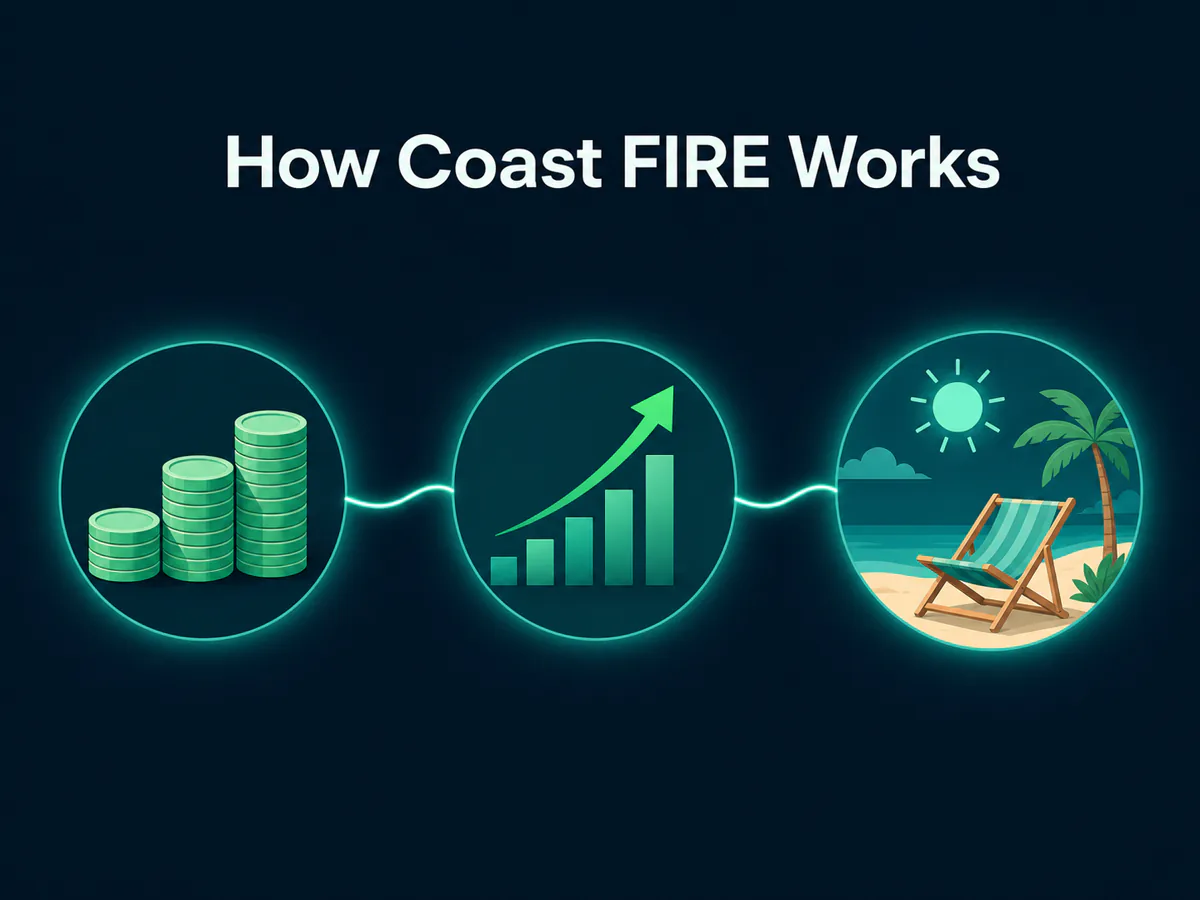
Coast FIRE is the amount of money you need invested today so that, left untouched, compound growth alone carries it to your full retirement target by the age you want to stop working. Once your savings clear that line, you can stop contributing to retirement accounts entirely and simply cover today’s expenses while the market does the rest.
The idea is popular. The part people skip is the arithmetic. Below is the formula, a full worked example with real numbers, and the assumptions that move your answer more than most calculators let on.
The Coast FIRE Formula
Coast FIRE Number = FI Target / (1 + r)^n
Three inputs, in plain terms:
- FI Target. The portfolio size you need to fund retirement indefinitely, commonly 25 times your expected annual spending (the inverse of a 4% withdrawal rate).
- r. Your expected annual real return, after inflation. Most projections use somewhere between 5% and 7%.
- n. The number of years between today and your target retirement age.
The formula is really just compound interest run backward. Instead of asking what a sum grows to, it asks what sum, invested now, grows to a specific target later.
A Worked Example
Say you are 35, currently have $60,000 invested, want to retire at 65, expect a 6.5% real annual return, and plan to spend $48,000 a year in retirement.
First, the FI target: $48,000 times 25 is $1,200,000.
Then n, the years to retirement: 65 minus 35 is 30.
Plug it in: $1,200,000 / (1.065)^30. That denominator works out to about 6.61, so the Coast FIRE number is $1,200,000 / 6.61, which is roughly $181,500.
You have $60,000 saved against a target of $181,500, so you are not there yet. You would need about $121,500 more invested today to coast the rest of the way. Every dollar you add now compounds for the full 30 years, so contributions in your 30s are worth far more toward this number than the same dollar added at 50.
The Assumptions That Actually Matter
The formula is one line, but three assumptions decide whether the number it spits out means anything.
Return rate. A 7% assumption gets you to Coast FIRE faster on paper than a 5% assumption, on the same savings. Real markets do not deliver a steady annual number, they deliver a bumpy sequence of good years and bad ones that averages out over decades. Run the calculation at more than one rate rather than anchoring to whichever one flatters your progress.
Retirement age. Because n sits in the exponent, small changes to your target retirement age move the answer a lot. Shifting from retiring at 60 to 65 gives your money five extra years to compound, which can lower your Coast FIRE number by a meaningful margin without you saving another cent. This is the single most underused lever in the whole calculation.
Inflation. Always work in real (inflation-adjusted) terms. A nominal 7% return with 3% inflation is closer to a 4% real return, and the difference compounds over 20 or 30 years into a very different number. If a calculator does not ask you to separate return from inflation, assume it is quietly using nominal figures and treat the output with caution.
Calculate Your Own Number
The math above is worth doing once by hand so you understand what is happening. After that, a calculator is faster and lets you test how sensitive your number is to each assumption.
Coast FIRE Calculator
Calculate how much you need saved today to coast to Financial Independence without additional contributions
Savings rate: 40.0%
Coast FIRE vs Barista FIRE
Both are ways to ease off full-time saving before you have a complete FIRE portfolio, but the mechanics differ.
Coast FIRE means your current savings, left alone, will compound to your full retirement target by your target age. Once you cross that line, you can work purely to cover today’s living costs and add nothing further to retirement accounts. The portfolio itself does the rest.
Barista FIRE assumes something different: a partial portfolio plus ongoing part-time income, indefinitely, into retirement. You never fully stop the part-time work; it is a permanent piece of the plan that fills the gap between what your investments produce and what you need to live.
In practice, Coast FIRE is a savings milestone with a fixed job at the end (keep working, at any pace, until your target age). Barista FIRE is a lifestyle with no end date on the part-time income. If you would rather stop contributing to investments as early as possible and let compounding finish the job, run the numbers on Coast FIRE first with the Coast FIRE calculator. If a permanently lighter workload is the actual goal, the Barista FIRE calculator models that instead.
Geo-Arbitrage Changes Both Sides of the Equation
Everything above holds for a single-country plan. Living somewhere with a lower cost of living changes two numbers in the formula at once: it lowers your FI Target (less annual spending to fund) and frees up more cash to invest today, which raises your starting balance and shortens how far you have to coast. Compare real cost-of-living data across more than 11,400 cities with the geo-arbitrage tool to see how relocating shifts your own Coast FIRE number, and read what Coast FIRE is for the full picture of how it compares to Lean, Barista, and Fat FIRE.
This article is educational and not financial advice. The formula and example above illustrate the mechanics of Coast FIRE; they are not a projection or guarantee of your own results. Markets do not return a fixed rate every year, and your actual outcome depends on your real returns, spending, and timeline.
Frequently Asked Questions
How do you calculate your Coast FIRE number?
Divide your FI target (the portfolio you need to retire, often 25 times annual spending) by (1 plus your expected annual real return) raised to the number of years until retirement. The result is the amount you need invested today for compounding alone to carry you to your target by that age, with no further contributions.
What is a Coast FIRE calculator?
A Coast FIRE calculator is a tool that runs the compounding formula for you. You enter your current age, current savings, expected retirement age, expected annual return, and target portfolio (or annual spending), and it tells you whether your existing savings will grow to that target on their own, and how much more you would need if not.
What return rate should I use to calculate Coast FIRE?
Most planners use 5% to 7% as a real (after-inflation) annual return for a diversified stock-heavy portfolio over long horizons. Higher assumptions make Coast FIRE look closer than it is. If you want a margin of safety, run the calculation at both 5% and 7% and plan around the lower number.
Does my Coast FIRE number change if I retire earlier or later?
Yes, significantly. The number of compounding years, n, sits in the exponent of the formula, so pushing your retirement age back even a few years lowers the amount you need saved today by a large margin, while retiring earlier raises it. Coast FIRE is far more sensitive to your target retirement age than most people expect.
How does inflation affect my Coast FIRE calculation?
Use a real return (nominal return minus expected inflation) rather than the raw market return, or your projected number will be inflated in both senses of the word. A 7% nominal return with 3% inflation behaves like roughly 4% in real terms, which changes the Coast FIRE number meaningfully over a 20 to 30 year horizon.
Free account required
Your result is ready. Create an account to reveal it.
Register free to see the complete result, save scenarios, and keep every calculator in one FI plan.
Free account. No credit card.